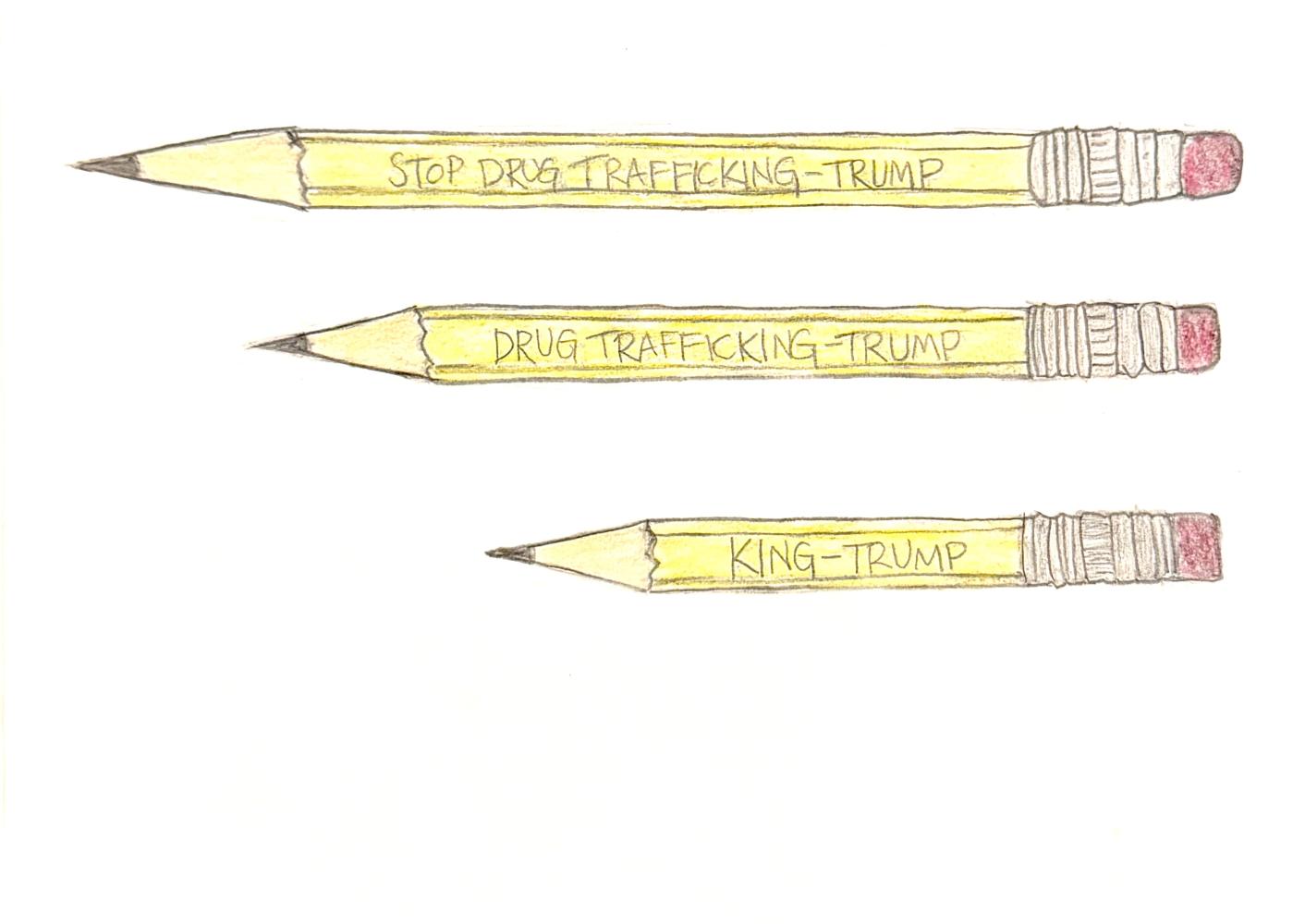
For some people, the phrase “war on drugs” conjures memories of the yearly school assemblies focused on the theme D.A.R.E. The local sheriff’s department would speak on the dangers of drug use while passing out pencils that read “Too cool to do drugs.”
In an ironic twist those pencils, when sharpened, shortened the slogan to a far less effective message: “Do drugs.”
But this is not that war on drugs.
This is a new war on drugs.
Today, a very different conflict is unfolding thousands of miles south of those distant memories. Located in the Caribbean Sea and along the Venezuelan coastline, the United States has deployed Navy ships, surveillance aircraft and, according to official statements, intensified counter-narcotics operations.
Despite these claims, many questions remain: Why Venezuela? Why now? And what is this truly about?
Is it Really About Drugs?
Under President Donald Trump, the U.S. has expanded military operations targeting alleged drug-trafficking vessels in the Caribbean. Military assets including an amphibious assault group and a nuclear-powered submarine are deployed along the coastline of Venezuela. Intelligence officials were also authorized to take covert action within the country.
Yet Venezuela accounts for only an estimated 8 percent of narcotics trafficked into the United States. By contrast, most fentanyl entering the U.S. originates in Mexico, and major cocaine production centers are found elsewhere in Latin America.
That discrepancy has raised suspicion and been challenged through reporting by many news outlets. Analysts, policy researchers, and even students are keeping an eye on global politics.
Many experts suggest the operation aligns less with narcotics control and more with efforts to create a regime change in Venezuelan President Nicolás Maduro.
Venezuela’s wealth in oil, minerals, gold and natural gas has long made it a geopolitical target. Several attempts have been made in the attempt to remove Maduro from power, including Operation Gideon, in 2020, involving a former US Special Services soldier.
The pattern has left some asking whether “the new war on drugs” is just a strategic attempt to bring about the same end game, a removal of the Venezuelan president from power.
But why? And how?
A Legal Loophole
Under U.S. law, presidents have three paths to begin military action:
- Congressional declaration of war,
- Congressional authorization of force, or
- Article II powers, which allow the president, as commander in chief, to use force in self-defense.
The Trump administration framed drug trafficking as an “invasion” that threatens American lives, thereby using Article II action without congressional approval.
The logic stretches the definition of self-defense. If drug traffickers can be framed as foreign invaders, what prevents future presidents, or other nation’s leaders, or even our own, from applying the same rationale to other nations or groups?
Why it Matters Here
Sierra College students are watching global events. A classroom survey was conducted in the last week of November 2025. Students say the issue reflects broader questions about presidential power, foreign policy, and how national decisions reverberate on local campuses.
Over 90% of students said they have been following recent global events. The majority of students reported they felt that national decisions, including presidential actions and foreign policy, have a real impact on them, on a local level.
Most students reported that global conflict is one of their biggest current concerns. When asked how global events affected the overall feeling of safety or stability, one student, Nia Marin, of Roseville, California, said:
“When I see instability or tension in the global political sphere, it puts me on edge and makes me concerned about the world around me. I understand that the national scale of political events is a reflection of my community, and vice versa.”
From immigration policy to public school funding and safety, students feel the impact in their everyday lives. Another student, Charlotte White of Lincoln, California said when she thinks about national issues, the biggest local impact she sees, relates to current drug concerns. She said:
“I have seen people in the community pass away from fentanyl poisoning, and I’m sure a lot of other kids my age… have heard or seen one of these stories firsthand.”
These concerns about safety and drug use surfaced repeatedly in student interviews. One student, when asked how global events affect his feelings of safety or security in the community or on campus commented on his personal safety. Logan Davis said:
“It makes you wonder whether you truly are ever safe on campus, especially… where it’s so open.”
In an interview on November 18th, 2025, Sierra College student Heidi Starr, offers her perspective in the 4 minute 37 second audio clip below. She talks about what the “war on drugs” means to her, what she thinks about sending the military to the Caribbean and off the coast of Venezuela, and how it affects her view of the current administration. Listen to the interview here:
End Game
From attacks on fishing boats to using legal loopholes to start conflicts, Trump’s current actions create more questions than answers, causing more worry than security.
What is the actual end game?
For a president who once promised “no new wars,” the pivot to military operations against Venezuela for alleged drug trafficking feels, to some, like a ride on the fast-spinning teacups at the county fair. It’s dizzying, unpredictable and potentially dangerous.
As the U.S. continues its operations against Venezuela and in the Caribbean, one thing is certain: this “new war on drugs” is reshaping a decades-old conversation, and a new generation of students are paying attention.
Reported, Written and Illustrated by Rachel Carnahan