Left, right, left, right
Americans are divided by political differences, but what do we agree on? One thing I discovered talking to students and community members is that each of them agreed on one thing: preserving Free Speech was deeply important.
In a phone interview on November 22, 2025, Nevada County Republican Party Chairman Mac Young shared his thoughts:
“Free speech is important to me because I want to be able to speak my mind without any repercussions. It’s so fundamental to being American.”
Young continued, “The foundation of the country was basically the protection of speech and even unpopular speech, because what may be unpopular one day, may be very popular the next. And so I think the free flow of ideas is essential for us to function as Americans in a free country.” He ended with this:
“It’s as important to me as oxygen.”
I visited the Sierra College campus in Grass Valley, on November 20th and interviewed a couple students, including Murphy B., who is majoring in Psychology. She expressed her concerns about the future of Free Speech, “It’s increasingly difficult to shake the feeling lately that the ground beneath the First Amendment is shifting. The feeling that openly speaking your mind on any public platform might be an act of quiet bravery, the price of which isn’t quite clear.” She said:
“It’s 2025, and we’ve come light years in the direction of civil and constitutional rights… or have we? It’s starting to feel a lot like George Orwell up in here.”
Murphy continued, “In the past few months, we’ve lived a surreal and dystopian reality I never thought possible, watching our First Amendment rights get thrown to the wayside in front of our very eyes.”
The First Amendment
Congress shall make no law respecting an establishment of religion, or prohibiting the free exercise thereof; or abridging the freedom of speech, or of the press; or the right of the people peaceably to assemble, and to petition the Government for a redress of grievances.
Free Speech is a bedrock of our democracy. Under the First Amendment, students have the freedom to engage in an open exchange of ideas. We grow intellectually by engaging in civil debate.
We are free to ask challenging questions, and even express unpopular, controversial opinions. This is how we introduce and tinker with new perspectives that eventually influence society.
The First Amendment was ratified on December 15, 1791 marking the first change to the Constitution. In the 20th century labor and civil rights movements would refer to the First Amendment to argue their civil liberties were being violated. And students began to assert their explicit rights, like the freedom to assemble, to publish and distribute their literature, and to speak out on issues that concerned them.
Free Speech Movement
All over the world, students have been at the forefront of social change. And in our region, the Bay Area holds an important place in history as a very active venue where ideologies are freely explored and debated in the community, and on campus.
UC Berkeley resides in the heart of Berkeley California, one of the most revolutionary hot beds in our country, yet the institution has mandated some of the strongest restrictions on students’ First Amendment rights over the years. In 1934, political activism, including demonstrations, were banned on campus.
In the 1950s, guided by the House Un-American Activities, ideologies perceived as “left wing” were feared to be a “communist plot.” This was the era of the Red Scare, and the political hysteria of McCarthyism.
Campus administration targeted faculty who held views differing from the conservative shareholders and Regents, deeming them “politically dangerous” and “communist.” The consequence was unjust persecution and the erosion of civil liberties, victimizing both students and faculty.
Onto the 1960s, students active in the Civil Rights Movement grew more intolerant of the repressive practices of their schools.
Faculty were required to sign a mandatory Loyalty Oath, and the university banned tabling and all forms of political advocacy, which would directly ignite the Free Speech Movement.
On October 1, graduate Jack Weinberg of the CORE (Congress of Racial Equality) was arrested for tabling without a permit. When police attempted to drive away, hundreds of students surrounded the vehicle, trapping it for 36 hours.
This incident sparked the Free Speech Movement , which organized and named itself within the next several days.
Bodies Upon the Gears
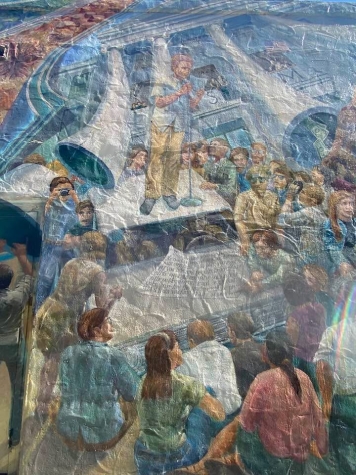
On December 2, 1964, UC Berkeley student Mario Savio delivered his historic speech, “Bodies Upon the Gears,” to a crowd of approximately 3000. Savio said:
“There is a time when the operation of the machine becomes so odious, makes you so sick at heart, that you can’t take part; you can’t even passively take part, and you’ve got to put your bodies upon the gears…”
He continues, “…and upon the wheels, upon the levers, upon all the apparatus, and you’ve got to make it stop. And you’ve got to indicate to the people who run it, to the people who own it, that unless you’re free, the machine will be prevented from working at all!”
Savio was a leader in a growing movement to resist violations against the First Amendment rights of students and faculty. The university had attempted to ban political and social activism on campus, resulting in the birth of the Free Speech Movement.
After a series of protests, UC Berkeley rescinded its attempt to stifle the free exchange of ideas. No longer would students be prohibited from setting up tables on the university grounds with political literature. This turning point began a long tradition that remains today, engaging in dialog and sharing literature.
Over the years many voices would ring through this plaza, calling for freedom and justice.
And I joined the chorus.
High School Students Speak Out
Over the years high school and college students led a vocal call for civil rights, staging boycotts, sit-ins and Freedom Rides. And the well known nonviolent civil disobedience staged at lunch counters, where white and Black students defied racist segregation.
The brave SNCC (Student Nonviolent Coordinating Committee) developed their own strategies to dismantle racist obstacles, and claim equanimity.
Years later, in 1968, the largest student protests in US history took place, led by high school students in Southern California. They staged the massive East LA Chicano student walkouts with 20,000 students boycotting seven different schools.
The walkouts were in response to civil rights violations and the systemic racism and inadequate educational resources faced by Chicano students. The students were prohibited from speaking Spanish, and suffered the impacts of underfunding, understaffing.
Students were discouraged from pursuing post secondary studies, as if they were incapable of academic work.
These young protestors endured a long, difficult struggle, but eventually were successful in breaking open a new path to reclaiming the resources and equanimity they and their community deserve.
Demands for Divestment
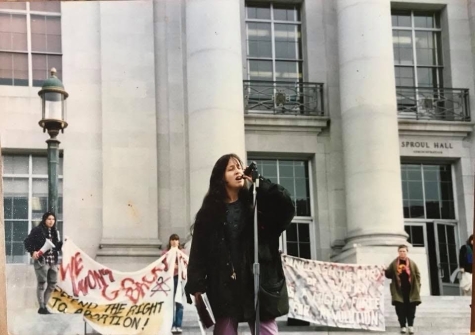
In the 1980s, on the steps of Sproul Hall, we protested against racism, social injustice, gender inequality and war. We called out the University of California’s direct investments in the unjust system of apartheid in South Africa. And it all took place on these steps of Sproul Plaza. Right where Mario Savio and others had torn down that repressive wall of censorship years before.
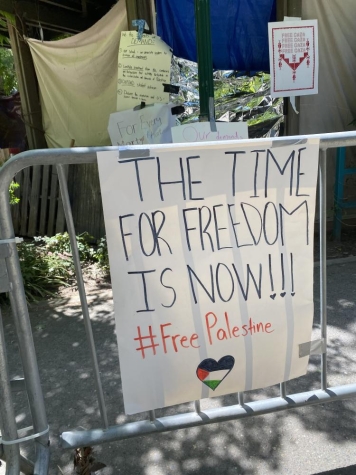
Like recent student protests imploring Universities to cease funding any direct ties to the Israeli government for what some recognize as genocide in Gaza, UC students acted similarly in the past.
They lamented their tuition aiding and perpetuating the inhumane crisis devastating the population of Cape Town and other South African townships where apartheid thrived.
All of this expression of dissent was protected under the First Amendment. We were practicing our Free Speech and Freedom to Assemble.
Sac State Students Speak Out
On April 29, 2024, I visited the CSU Sacramento campus and interviewed Sarah, a Palestinian American Sac State student, whose last name I’ve omitted for safety. Listen to the 3 ½ min. interview and sounds of the protest.
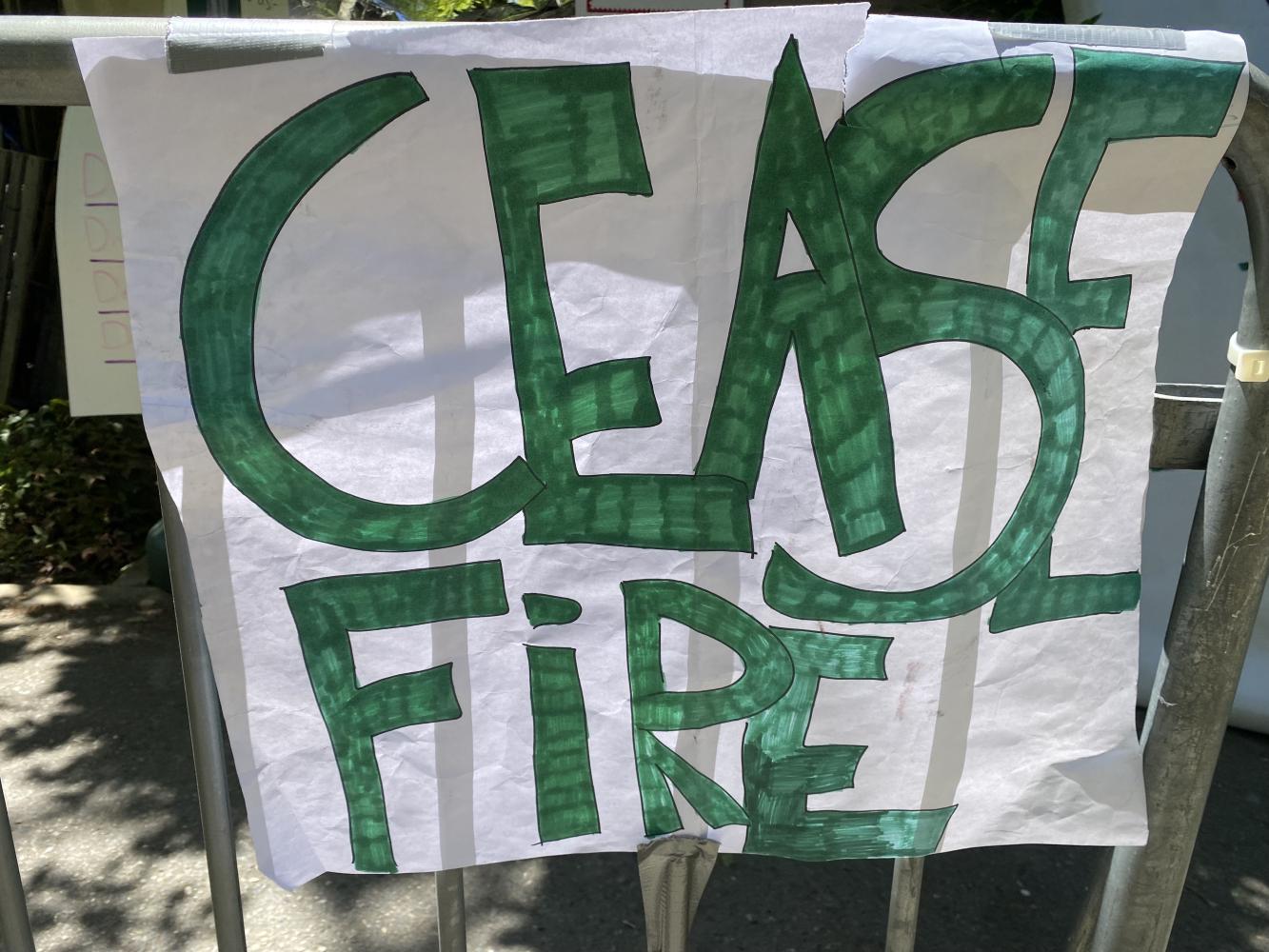
It was a peaceful atmosphere on the library quad, where about 100 pro Palestinian students and community supporters, had just set up an encampment that morning. They were there to protest the Israeli government’s continued assault on Palestine. Under a large shady gazebo, draped with vines, there were several tents, a makeshift kitchen and tables displaying literature.
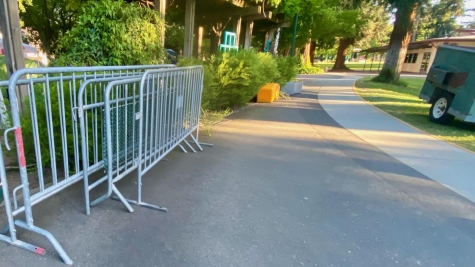
The space was encircled by a link of metal crowd barricades provided by the campus, to offer a measure of safety for the demonstrators. The group was made up of a diversity of students, including Jewish Voices for Peace and Students for Justice in Palestine, inspired by demonstrations happening on campuses all over the country.
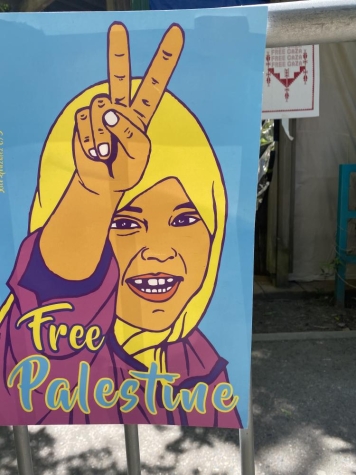
A couple weeks later, on May 8, 2024, I visited the campus the day that students and CSUS administration reached an amicable agreement, and the encampment came to an end. The institution amended their policy.
They formally committed to not engage in any activity that promotes genocide, ethnic cleansing, and activities that violate fundamental human rights. The administration also agreed to investigate and implement socially responsible investments from this point on.
The campus administration respected the freedom of the students to assert their First Amendment Rights to peaceably assemble and express their Free Speech. And the students likewise were resolute in their stance, as well as nonviolent and peaceful. It was an inspiring example of Free Speech in action.
No matter the topic, politics, and ideologies expressed, the First Amendment guaranteed the rights that allowed for this demonstration to take place. Students across the political spectrum, from conservative to progressive, all have the right to Free Speech.
A New McCarthyism Emerges
Since then, however, the current state of Free Speech on American campuses has devolved. Soon after the inauguration in January 2025, the Trump administration ushered in a series of attacks against students who engage in demonstrations. Student visas have been revoked in retaliation for expressing ideologies the President opposes.
Some students perceived to be “leaders” have even been arrested, like Columbia University graduate student Mahmoud Khalil. In a shocking move, Immigration agents arrested Ph.D. student Rümeysa Öztürk, a Fulbright scholar, at Tufts University in response to an OpEd she wrote.
Faculty at several Universities have been fired, and some Universities have capitulated to demands by what many call an increasingly authoritarian leadership. For example, UC Berkeley disclosed the names of 160 students, faculty and staff to the Trump administration, in what many are calling an act of backlash against their political ideologies.
In response, thousands called out UC Berkeley’s controversial acquiescence to the federal government, drafting a statement in September, 2025, opposing the blanket accusation of “antisemitism” signed by more than 200 UC Jewish faculty. Differentiating the practice of hate speech from Free Speech is a key component in their defense.
In recent months, the Constitution, including the First Amendment, has suffered blows not experienced since the McCarthy era, and students across the country are pondering exactly how strong our democracy is.
Because I Would Be Silenced
“Because I Will Be Silenced” by Ha Jin
Once I have the freedom to say
my tongue will lose its power.
Since my poems strive to break the walls
that cut off people’s voices,
they become drills and hammers.
But I will be silenced.
The starred tie around my neck
at any moment can tighten into a cobra.
How can I speak about coffee and flowers?
*******
In an abusive relationship, the aggressor attempts to sell the fantasy that they are so “powerful,” there is no choice for the victim except to curl up in a ball and surrender. And the same is true with leaders who abuse power.
We can shrink fearfully into silence, or we can take these unconstitutional challenges as an inspiration to raise our voices. In unison.
After all, students have always been a beacon leading the way back to sanity when society has stumbled off course.
Speaking freely, sharing fresh ideas, debating and challenging our minds to expand… this is the beauty of our right to Free Speech.
What will your message be?
Reported and Written by Heidi Starr
the Spring of 2026.