Grass Valley, Calif. — Protest has long been a way for people in the United States to express frustration and demand change, from the Vietnam War era to today’s debates over immigration, policing, and global conflict. While the issues have changed over time, one question still remains: what actually comes from these moments?
That question came up in Grass Valley, when a small group of protesters gathered outside the Grass Valley Police Station on Friday, February 27, 2026. Sitting inside Caroline’s Café across the street, it was hard not to notice them. About 20 young people stood holding handmade cardboard signs, trying to get the attention of passing cars and pedestrians.
Many Messages, One Question
Some signs focused on immigration and read “ICE OUT.” Others mentioned global issues like Palestine, while a few called for accountability more generally. The messages weren’t all the same, but they shared a similar feeling—frustration, urgency, and a need to be heard.
The group began chanting for a short time. Soon, many of the protesters walked past the Café and came inside. They set their signs down and started talking with each other. The protest itself ended quickly, but the conversations continued.
Protests like this have been happening more often, the fatal shooting involving federal immigration agents in Minnesota drew more attention to the public. But when so many topics show up at once, it can be hard to tell what the main message is.
That raises an important question: how do these protests turn into real change? Awareness is a starting point, but it doesn’t always lead to clear action on its own.
A Youth’s Perspective
In an interview conducted at Caroline’s Café following the protest, Tori, a 15 year old female student at Nevada Union, said she felt pulled to attend the demonstration. When asked what specifically brought her out, she described a general sense of overwhelm tied to both her environment and current events.
“It’s just… everything,” she said. “Everything I see at school, everything I see on the news.”
She also shared that her perspective developed through personal experience. “It became important to me at Bear River School,” she said, describing it as a “major culture shock.” At her time attending the school as a student she witnessed racism that made these issues feel more immediate and real in her daily life.
While she said she wants to see change come from protests, she emphasized that education and conversation are key. “I would like people educating themselves,” she said.
“There’s a lot of ignorance out there, especially on social media. People are just taking things at face value. I think if people just got together and talked things out, it would be much better.”
For her, the audience is not only officials, but also her peers. “I want people to feel supported,” she said and explained:
“I want change to happen, but I also want people to know they’re not alone. That’s what I love about protests—it brings awareness and makes people feel safe.”
When asked about accountability, she acknowledged the complexity of the issue. “Accountability is hard,” she said.
“I just wish there was a way to make people understand the pain they cause—to have empathy.”
She added that while she does not necessarily oppose the idea behind immigration enforcement, she questions how it is being carried out.
Her perspective reflects how many young people are engaging with complex issues—motivated by awareness and emotion, while still working to turn those feelings into more defined understanding and action.
A Generational Perspective
At a separate demonstration held on March 30 at the Nevada City Bridge, another protester, Elan, who asked to use her first name only, reflected on a longer history of political engagement.
When asked what first inspired her to become politically active, she pointed to the Vietnam War. “That’s where it started for me,” she said, connecting past movements to current demonstrations.
For Elan, protests serve less as a direct tool for change and more as a way to connect with others and gauge public sentiment. She said:
“It’s an opportunity to get out and find others who feel the same way. It gives you a sense of camaraderie—that you’re not alone in your frustration.”
Elan continued, “It doesn’t technically do anything, but it shows who might be going out to vote.”
On this point, she emphasized the importance of civic participation and voting beyond protest. She said, “Vote. Whatever it is that you believe, you need to vote. The idea is to get people into office who will actually make changes.”
She said events like these still give her hope:
“Seeing people out here today—and even people driving by who agree—reminds me that others are paying attention.”
From Protest to Conversation
A few days before the protest, a different kind of event took place at the Miner’s Foundry in Nevada City. “The Stand Together Against Ice Meeting,” held on February 5th, brought people together to talk, ask questions, and share resources.
Unlike the protest, there were no chants. Instead, attendees participated in group discussions about how the community might respond if immigration enforcement became a local issue.
However, at times the meeting took on a more expressive tone, with participants focusing on frustrations surrounding national politics, including criticism of President Donald Trump and federal immigration policies.
While the event created space for people to voice concerns, there was less emphasis on identifying clear, actionable steps moving forward.
Taking It to City Hall
The same concerns raised at the protest and community meeting were brought into a more formal setting during a Nevada City Council meeting held on Feb. 11.
During the meeting, Mayor Kline referenced community concerns that had been discussed at the Miner’s Foundry, including questions about immigration enforcement and surveillance systems such as Flock license plate readers.
Nevada City Police Chief, Daniel Foss addressed those concerns directly, clarifying how the technology is used. “Flock is a brand, not a technology service,” he said, explaining that while the department has access to license plate reader systems, “…we do not have these cameras in these cities.”
He added that the system primarily logs time and date data and that any information sharing with federal agencies would be handled with discretion. “If it gets to the point of a major case, a federal agency may approach, and the Chief has the authority to share or not share,” he said.
The Chief acknowledged the broader tension between public safety and privacy. He said:
“We walk the line with technology and individual freedoms.”
Council members also raised questions about how decisions are made within law enforcement. In response, the Chief emphasized the importance of community input. He said:
“What is super important is to not get stuck in a law enforcement mentality… Weigh costs and talk to members of the community—we are working towards that.”
Different Spaces, Same Conversation
Looking at the protest, the community meeting, and the city council discussion, each reflects a different part of the same conversation.
For the student protester, the demonstration was about awareness and connection. For Elan, who has been protesting since the Vietnam War, it is rooted in long-term civic action. At the city level, those same concerns take on a more procedural form.
Each space serves a purpose, protests draw attention, community meetings create dialogue, and city council addresses policy. But on their own, each remains incomplete.
What happens next is less visible. The energy from the street doesn’t disappear, it shifts. In quieter spaces, conversations continue, ideas are questioned, and perspectives begin to take shape.
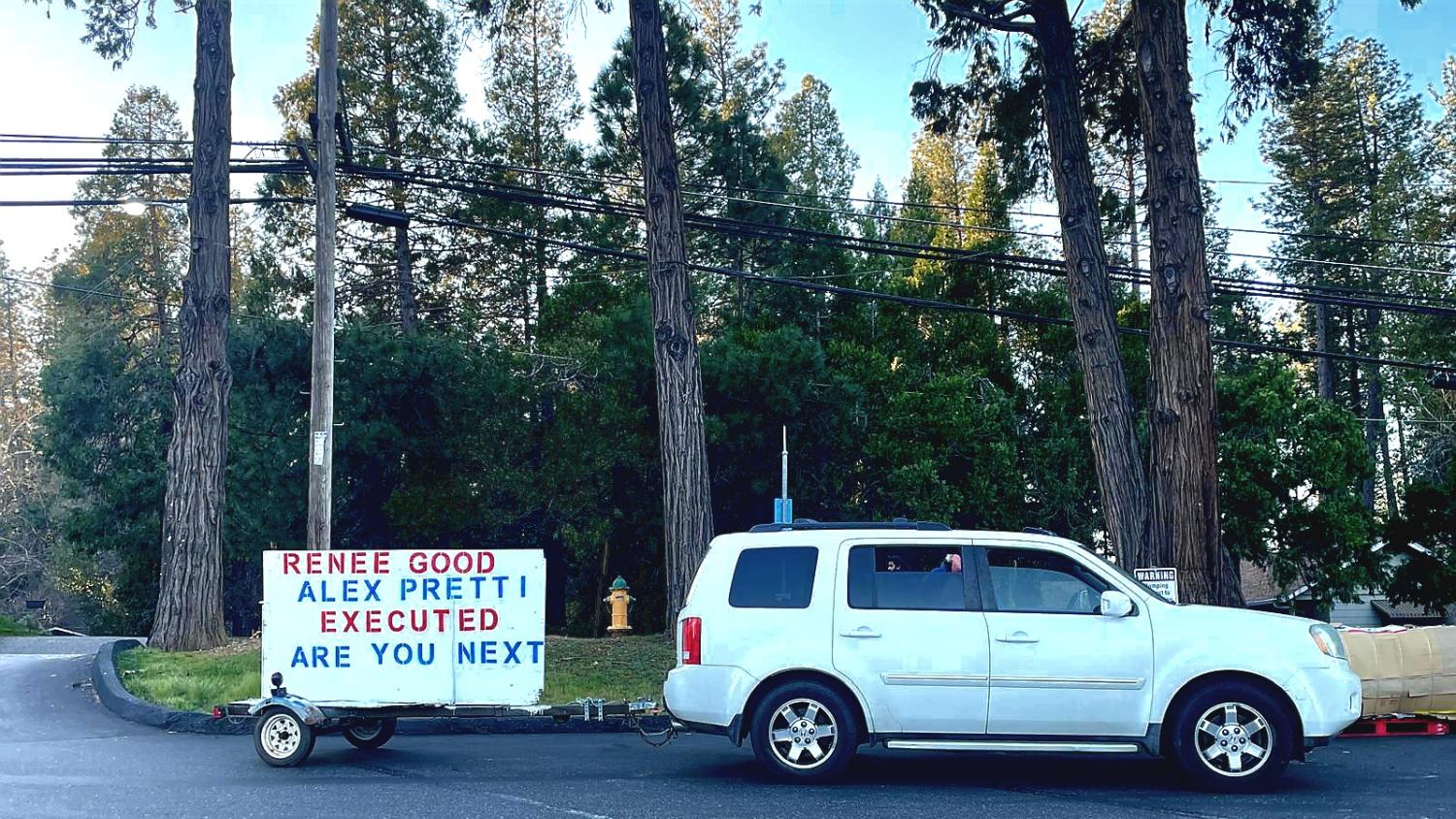
*Editor’s Note: The featured photo documents a vehicle towing a plywood sign that states, “Renee Good, Alex Pretti/Executed/Are you next,” parked at the Nevada City SPD Market on Feb. 5, 2026. Photo by Andrea Acklin.
Reported and Written by Andrea Acklin