As digital newsprint and a variety of new media forms emerge, tangible forms like newspapers are often buried with the lede. Print student publications, once vibrant and informative sources about the campus community, thrived at Sierra College before trickling away. What does Sierra’s student journalism look like historically? And what does the future hold?
Yearbook Legacies
Despite numerous name and campus location changes throughout the 20th century, student print publications at Sierra College flourished on campus. Print journalism at Sierra begins with “Potpourri,” a yearbook originating in 1902, before Sierra College as we know it even existed.
Initially published by Placer County High School journalism students, the “Potpourri” yearbook dove into all aspects of student life and activities, including academics, clubs, the educators and administration on campus, horoscopes, and more. Embracing creativity and artistic freedom, the early yearbooks weren’t always perfect and neat, but showed the passion students poured into them year after year.
The “Potpourri” yearbook continues on at Placer High School today, but Sierra branched off into the “Phoenix” yearbook around 1940.
The “Phoenix” yearbook launched as the product of a journalism club at Placer Junior College, and covers campus updates, such as the transition from Placer Junior College to Sierra College. A particular yearbook entry on page three of a 1953 edition of a Phoenix states:
This year, with progress as our theme, ‘Phoenix’ retains its ancient meaning and becomes symbolic of the future. Placer College destroyed itself, to be recreated as Sierra College through the efforts of its own: Administration, Faculty, and Students.
This rather poetic statement proves how the yearbooks document the birth of Sierra College as we know it, providing us with a glimpse into the world generations before us.
As Placer Junior College yielded to make way for Sierra, so did the “Phoenix” for the “Sierran” yearbook in 1954. The “Sierran” picked up where the “Phoenix” left off until the publication ended in 1972. After the “Sierran” died out, a yearbook never returned to Sierra College.
Out with the Old, In with the New
Journalism at Sierra College diverted into separate rivulets as media forms changed over time, with various journalistic outlets supported on campus. As yearbooks became obsolete at Sierra, the literary journal on campus formed, as well as a print newspaper.
The Sierra Journal, formerly The Viewpoint and I Am, serves as a collection of Sierra students’ literary compositions. Prose, poetry, fiction, and more dance across the pages and years of this long-running publication, exploring students’ experiences, imaginations, and raw emotion. Beginning in 1960, the Sierra Journal lives on today with older print copies accessible through the Sierra College Library Archive.
In the 1960s, the seed for a student newspaper was planted, and the idea took off. Running until the early 2000s, Sierra College’s print newspapers serve as excellent time keepers of local and national historical events.
Advertisements speckled each page, and black and white images began to bleed color as mediums and technology evolved. Layout techniques, font styles, image formatting, and more differed drastically between each publication, emphasizing the individuality and personality behind the students who contributed.
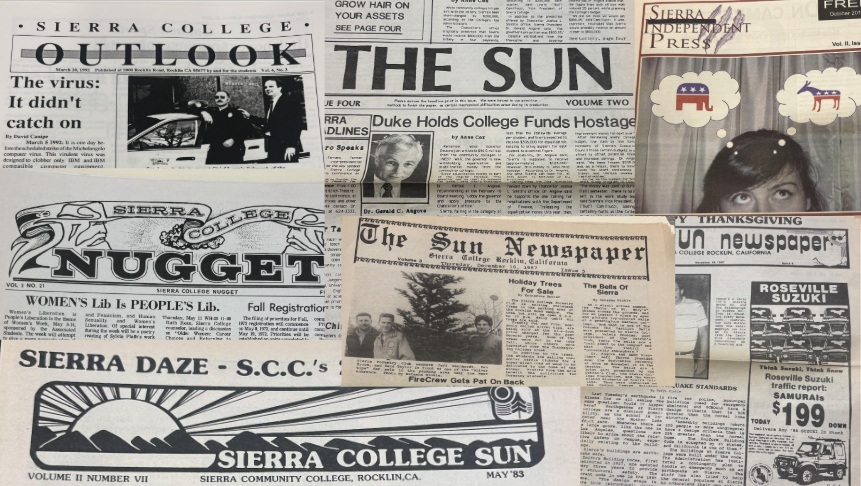
The student newspaper ran under the names: The Nugget, the Sun, Spectrum, the Outlook, and, finally, the Sierra Independent Press.
The newspapers ran relatively smoothly until Sierra College’s national publicity scandal surrounding an op-ed released by the Outlook newspaper in 2003. The controversial op-ed, titled, “Sierra Girls Aren’t That Hot,” led the Outlook to be under intense public scrutiny as claims of the article’s sexism and ignorance battled cries for Student Free Speech and press.
Becoming Independent
Rising from the rubble of the Outlook’s tarnished reputation came the Sierra Independent Press. Although this publication looked essentially the same as its predecessors, the Sierra Independent claimed to be “published independently by students at Sierra College,” disclosing on the front page that the Sierra College District is not, “responsible for the contents of any of the articles, advertisements, promotions, or editorials herein,” Sierra Independent Press, 2009-2010. With this new paper, a completely autonomous form of student newspaper was born on Sierra’s campus.
Taking a step back into time and scouring old Sierra College print publications tossed me into time periods completely foreign to me, over a century ago even. The student collaboration and creativity beamed out from each story, igniting my creative fire as I read. Each group photo of smiling students or a featured campus activity in the old newspapers highlights the tight-knit community that existed between students and administrators on campus in years past.
Inspired and invigorated to join a campus group or club involved in student newspapers or journalism of any kind, I hit a wall. No print publications exist on Sierra’s campus anymore. There is no physical newspaper or magazine produced through a class or program. I found no journalism or media club for me to collaborate with like minded students outside of a class setting, as the past media club on campus was dormant upon my arrival at Sierra.
Distraught by the lack of a publication so integral to a college campus, but feeling powerless to change anything, I continued pursuing Journalism and Communication Studies classes. Then, in spring of 2026, I met Heidi Starr, a motivated student with a mission: bring back the student newspaper at Sierra College. I immediately became intrigued in Starr, her background, and her journalistic passions.
Our Newspaper Starr
In a phone interview on April 5, 2026 with Heidi Starr, I was interested in understanding how she got to where she is now and her story. What are her motivations? What inspires her? I was truly curious about the “why” behind Starr’s motivation to start a newspaper. When asking about her background in Journalism, she said:
“What really turned me into a journalist is my activism.”
She continued, “At about 19 years old, I was introduced to social justice movements in Berkeley.” She said she felt she found her people and fit in among the other activists.
Starr participated in campaigns and protests for various causes: environmental, animal cruelty, women’s rights, etc. Then eventually, she was exposed to journalists through being an interview subject. Starr said:
“The media does not always report things accurately… You have to be so selective to find that good journalist who’s willing to be not biased and tell the full true story.”
Starr recognized the need for ethical journalists, stating, “News and reporting to me is just sort of like a necessity. The part of me that wants to help stop suffering in the world is like, okay, this is one of the ways to shine a light on the things happening, help other people that are speaking up.”
Sharing others’ stories ethically is a key part of the interview and journalism process for Starr, which she has practiced through radio. Starr landed in the radio industry in 1995 and worked for decades as a volunteer broadcaster for KVMR FM, a community radio station in Nevada City, where she still submits content.
As to her educational journey, Starr currently attends Sierra College pursuing her third Associates degree from the institution in Social Justice. Her prior degrees obtained in recent years were Journalism and Communication Studies.
Across Media, Choosing Print
Upon arriving at Sierra College in 2023, Starr noted a stark lack of student newsprint. She said, “It was surprising to me to see that it didn’t exist when it exists in all these other places [high schools, colleges, small towns] still.”
Starr remarked how growing up, there was always a community newspaper or newsprint to read at breakfast, a nostalgic memory for many, primarily forgotten with the grand entrance of high-speed internet and mobile phones.
Despite the lack of student newsprint on campus, Starr found another journalistic outlet through Roundhouse News, an online student publication run through Sierra College Journalism program. Here, she wrote and published powerful pieces digitally alongside her peers in an online journalism format. This format is what most colleges have adopted as the web became cheaper, faster, and more accessible compared to print.
Although still submitting content at KVMR FM, Starr lamented the gaping hole where print journalism used to exist at Sierra College. Armed with moxie and determination, Starr pushed forward into the realm of print paper, reaching out to other students, researching, perusing archives, hanging up flyers, and connecting with Sierra faculty.
Under the advice of Journalism professor Jen Vernon, Starr set about restarting the Media Club, formerly known as CommJaM (Communications, Journalism, and Media Club, 2019-2025), and before that, Media Club, 2011-2019.
With a small group of dedicated students she recruited, myself included, the Media Club was officially formed. After preliminary meetings, officers were chosen, and Starr’s team began officially planning the newspaper.
New Journalists at Work
As novice journalists, the task of starting a paper seemed daunting. Producing content and writing for a newspaper isn’t always conducive with a busy home, school, or work life. On top of the general story writing and interviewing process, the behind-the-scenes work sneaks up on you.
There was layout, word count, publishers, columns, categories, editing, financial limitations, images, formatting, fonts, on and on! As intimidating as a task the paper was, we were ready to tackle the challenge using ingenuity, open communication, and flexibility.
Gianna Azbill, Media Club president and member of the 2026 Student Senate, is a Sierra student on the Rocklin campus studying Communication Studies. She has been an invested part of the newspaper planning process from day one. In a student spotlight interview conducted by by Starr, Azbill was asked about her experience as co-president of the Club. She said:
“It inspires me because I feel like everybody deserves a voice on campus. And I mean everybody.”
Azbill continued, “And also, it’s a great way to keep track… like I love looking back at the old archives… It just shows how important that documentation is, right? And I think it’s a way of keeping people accountable as well.”
The Newspaper Team consists of people of all ages, backgrounds, and education levels. Students fresh out of high school work with others who’ve been in the workforce for the past couple decades and have come back to expand their education, alongside others with different life situations and experiences. Heidi emphasized the importance of diversity in the learning process:
“I also want to learn from people who are fifteen or twenty or whatever…you guys are so brilliant in a certain way, so much to teach me.”
The difference in ages allows for people with familiarity in all media forms and mediums to collaborate and teach each other new things. When it comes to design details in the newspaper and the nitty gritty, Starr is unconcerned with achieving perfection. While discussing past Sierra papers, Starr said:
“I love how when you look at all the old student newspapers, some of it is really casual…I like the realness of that. And how you hear that person’s voice.”
Creating Together
As a part of my journey collecting fragments of Sierra’s history, I scoured hundreds of pages of Sierra yearbooks and newspapers. While doing so, I captured some of the old ink doodles, borders, and drawings from prints dating back to Placer High in 1902. These are scattered throughout the first issue of the new paper, blended with new design and art created by the current Newspaper Team.
Straying away from the traditional design standards isn’t to be feared in this new paper; it’s to be encouraged and embraced. The Newspaper Team welcomes art, border, and design submissions, as well as photography, comics, fashion, and more.
The Newspaper Team has meetings consistently to share the design and editing process, and the Media Club meets monthly.
Several meetings of the Newspaper Team were dedicated to perusing the newspaper archives at the Sierra College Library and the Placer County Archives office. The tangible newspaper copies reminded us what the end goal of the project is.
If a newspaper was attainable for students decades ago, then we are able to accomplish it. As of right now, the Newspaper Team aims to produce their first paper by the end of the spring semester, in May 2026.
Starr states, “I think I’m so passionate about it just because it is an avenue for students to communicate with, you know, their campus community and to have an autonomous voice… it’s sort of like a free speech zone on paper.”
Collaborating with a team of students sharing the same vision and goal is a special experience. Much value has been found in instilling and receiving new knowledge, listening to the ideas and stories of others, and working as a team to create a piece of art, literature, and history all wrapped up in one.
*Editor’s Note: The featured image on this story is a collage of covers of past Sierra College student newspapers: the Outlook, Nugget, Sun, and Sierra Independent Press, that were arranged and photographed by Rylee Nordyke during a Newspaper Team visit to the Sierra College Library Archives, Rocklin campus, Mar 2026.
Reported and Written by Rylee Nordyke